

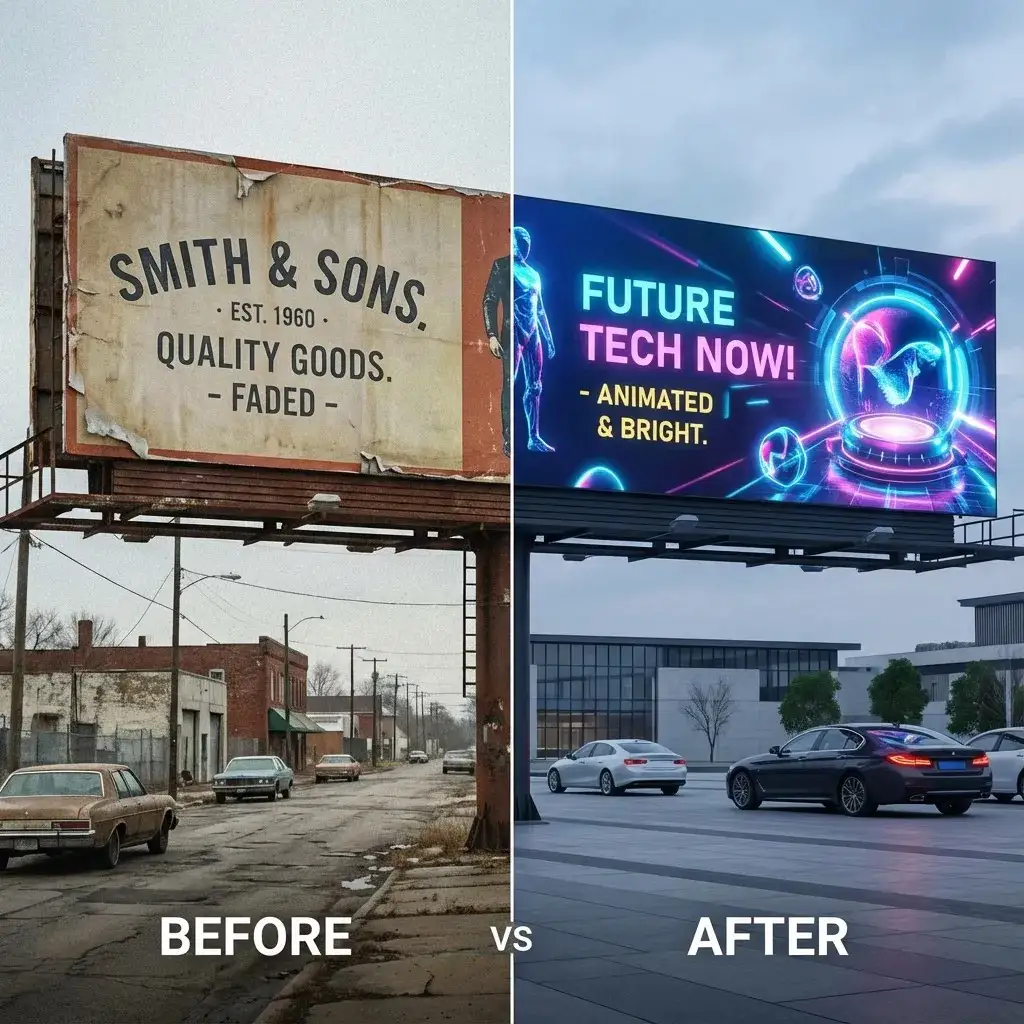
A Beginner's Guide to Transitioning from Static to Digital Billboards
If you've been running static billboard campaigns for years, the shift to Digital Out-of-Home (DOOH) might feel daunting.
New technology, different buying models, and unfamiliar metrics can seem overwhelming.
But here's the truth: DOOH isn't about replacing what works - it's about making it work better.
This guide breaks down everything you need to know about transitioning from static to digital billboards, covering the real costs, benefits, and practical steps to get started.
📊 Static vs. Digital: A Quick Comparison
| Factor | Static Billboards | Digital Billboards (DOOH) |
|---|---|---|
| Creative Flexibility | One design for entire campaign | Multiple creatives, real-time updates |
| Production Time | 1-2 weeks (printing, installation) | Hours (upload and go live) |
| Production Cost | ₹15,000-50,000 per vinyl print | Zero print cost, digital upload only |
| Campaign Changes | Reinstallation required | Instant remote updates |
| Booking Model | Monthly or quarterly slots | Hourly, daily, or loop-based |
| Targeting | Location only | Location + time + audience + context |
| Measurement | Estimated traffic counts | Real-time impressions and analytics |
💡 Key Benefits of Digital Billboards
1️⃣ Speed to Market
With static, a campaign might take 3-4 weeks from creative approval to going live.
With digital, you can be live in 24-48 hours.
Use Case: A movie releasing on Friday can book screens on Wednesday with final creative - impossible with static.
2️⃣ Creative Flexibility
Run multiple creatives on the same screen:
- Morning message for commuters
- Evening message for shoppers
- Different offers for different days
Use Case: A restaurant shows "Breakfast Specials" at 8 AM and "Date Night Deals" at 7 PM - same screen, different value.
3️⃣ Real-Time Changes
Made a pricing error? Competitor launched something? Event got cancelled?
Update your creative instantly without any physical work.
Use Case: An airline updates fare prices on billboards in real-time based on seat availability.
4️⃣ No Printing Costs
Static campaigns require:
- ₹15,000-50,000+ per vinyl print
- Multiple prints for different locations
- Disposal costs and environmental waste
Digital eliminates all of this - pure media cost, no production waste.
5️⃣ Better Measurement
Static measurement = "We estimate 50,000 vehicles pass daily."
DOOH measurement = exact play counts, verified impressions, and audience analytics.
Use Case: Know exactly that your ad played 1,500 times, reached an estimated 89,000 unique viewers, and had peak visibility between 5-7 PM.
💰 Understanding DOOH Costs
One of the biggest concerns for traditional advertisers is cost. Let's break it down:
Buying Models
| Model | How It Works | Best For |
|---|---|---|
| Slot/Loop Based | Buy X plays per hour on a specific screen | Guaranteed visibility on premium screens |
| CPM (Cost Per Thousand) | Pay based on impressions delivered | Performance-focused campaigns |
| Programmatic | Bid in real-time auctions | Maximum flexibility and optimization |
| Fixed Duration | Book screen for hourly/daily blocks | Domination and takeover campaigns |
Cost Comparison Example
Campaign: 2-week awareness drive in Mumbai
| Expense | Static | Digital |
|---|---|---|
| Media Cost | ₹3 lakh | ₹4 lakh |
| Production | ₹50,000 (printing) | ₹0 |
| Installation | ₹30,000 | ₹0 |
| Creative Changes | ₹50,000 (reprint) | ₹0 |
| Total | ₹4.3 lakh | ₹4 lakh |
| Impressions | Estimated | Verified |
| Flexibility | None | Full |
Result: Digital often costs the same or less when you factor in production and flexibility.
🚀 Getting Started: Practical Steps
Step 1: Audit Your Current Static Campaigns
- Which locations perform best?
- What's your current production spend?
- How often do you need creative changes?
Locations with high change frequency are ideal first candidates for digital.
Step 2: Identify High-Value Digital Locations
Not all locations have digital screens. Start with:
- Malls and retail centers (high dwell time)
- Metro stations and transit hubs (captive audience)
- Airports (premium demographics)
- Major arterial roads (high-impact screens)
Step 3: Start with a Pilot Campaign
Don't convert everything at once. Run a 2-4 week pilot:
- Select 5-10 digital screens
- Compare performance vs. equivalent static locations
- Test multiple creatives to see what works
Step 4: Learn the New Metrics
Key DOOH metrics to understand:
| Metric | What It Means |
|---|---|
| Plays | Number of times your ad displayed |
| Impressions | Estimated viewers based on footfall |
| Loop Share | Your share of screen time vs. other advertisers |
| Proof of Play | Verification that ad ran as scheduled |
| Dwell Time | Average time viewers spend near screen |
Step 5: Scale What Works
Once you've validated digital:
- Shift more budget from static to digital
- Explore programmatic buying for efficiency
- Test advanced features like DCO and retargeting
🎨 Creative Considerations for Digital
Digital billboards have different requirements:
| Element | Recommendation |
|---|---|
| Duration | Design for 10-15 second attention spans |
| Motion | Subtle animation increases attention by 30% |
| Text | Maximum 7 words - viewers are moving |
| Contrast | High contrast for outdoor visibility |
| Format | Common resolutions: 1920x1080, 3840x1080 |
| File Types | MP4, JPG, PNG (check screen specs) |
Pro Tip: Your static creative will need adaptation. Don't just upload a vinyl design - optimize for digital.
⚡ Common Concerns (And Answers)
"Digital screens are too expensive"
Reality: When you factor in production savings and flexibility, total costs are often comparable.
"I don't understand the technology"
Reality: Platforms like Adcentra.ai make booking digital as simple as selecting screens and uploading creative.
"My audience prefers traditional advertising"
Reality: Your audience doesn't know or care if a billboard is static or digital - they just see your message.
"Measurement seems complicated"
Reality: Digital actually simplifies measurement by giving you exact data instead of estimates.
"I'll lose relationships with my current vendors"
Reality: Many static vendors are adding digital inventory - you can often work with the same partners.
📈 Case Study: Traditional Brand Goes Digital
Client: A regional FMCG brand with 15 years of static OOH experience.
Challenge:
- Long production cycles meant missing market opportunities
- No measurement beyond "estimated traffic"
- Expensive reprints when promotions changed
Solution:
- Shifted 40% of OOH budget to DOOH
- Used Adcentra.ai for booking and management
- Ran time-based creatives (morning/evening variations)
Results:
| Metric | Before (Static) | After (Digital) |
|---|---|---|
| Campaign Launch Speed | 3 weeks | 3 days |
| Production Costs | ₹8 lakh/year | ₹0 |
| Creative Variations | 1 per campaign | 4-6 per campaign |
| Measurement | Estimates only | Verified impressions |
| Campaign Performance | Unknown | +28% recall measured |
The brand has since shifted to 70% digital and continues to see improved results.
🏁 Conclusion
Transitioning from static to digital isn't about abandoning what works - it's about evolving.
Digital billboards offer:
- ⚡ Faster campaign launches
- 🎨 More flexible creative options
- 📊 Better measurement and accountability
- 💰 Comparable or better cost efficiency
With platforms like Adcentra.ai, the transition is easier than ever. Start with a pilot, learn the metrics, and scale what works.
👉 Ready to explore digital OOH?
Visit Adcentra.ai and discover how easy it is to book your first digital billboard campaign.
💬 FAQs
1️⃣ Are digital billboards more expensive than static?
Not necessarily. While media costs may be slightly higher, you save on production, printing, and installation - making total costs often comparable or lower.
2️⃣ Can I use my existing static creatives on digital screens?
You'll need to adapt them. Digital has different aspect ratios, supports motion, and benefits from shorter, more impactful messaging.
3️⃣ How quickly can I launch a digital OOH campaign?
With Adcentra.ai, you can be live in 24-48 hours - compared to 2-4 weeks for traditional static campaigns.
Published by Adcentra.ai - Building the future of intelligent outdoor advertising in India.